






Does ChatGPT recommend your business? How to check in five minutes
By Krystian Swierk, Kreate Vision, Palatine IL
Open ChatGPT, Google, and Perplexity, type your service and your town, and read what comes back. If your business is not named or cited in the first answer on any of the three, that is your actual AI visibility today, not a guess.
This check takes about five minutes and needs no software. Below are six prompts to run, what “named,” “cited,” and “absent” actually mean, and the three most common reasons a real business goes missing from an answer it should be in.
Six prompts to type into ChatGPT, Google, and Perplexity
Swap in your own service and town. Use the town people actually search, not just the one on your letterhead.
- “who is a good [service] in [town]”
- “best [service] near [town]”
- “recommend a [service] company in [town]”
- “[service] [town] Illinois”
- “[service] near me, I live in [town]”
- “top rated [service] in [town]”
An example from a Chicagoland trade: “who is a good kitchen remodeler in Arlington Heights.” Run that exact phrasing, then the five variations, in three places: ChatGPT’s normal chat box, Google (once as a plain search to see if an AI Overview appears, once in the AI Mode tab if your account has it), and Perplexity’s default search box, which already answers live.
Eighteen checks sounds like a lot. In practice most answers repeat after the second or third prompt, so five minutes covers it.
How to read what comes back: named, cited, or absent
Named, cited, or absent are the three outcomes, and they are not the same thing.
Named. Your business appears by name inside the answer text itself, as one of the businesses recommended.
Cited. Your page shows up as a linked source under or beside the answer, but the prose names competitors, not you. ChatGPT and Perplexity show these as small citation links; Google’s AI Overview shows a row of linked sources you can expand.
Absent. Neither. The answer names other businesses, or hedges with generic advice, and your page appears nowhere in the sources.
Being cited without being named still means the model read your page and thought it relevant enough to link. That is a different, better position than absent, and worth telling apart. See SEO gets you ranked, AEO gets you quoted for why ranking on Google and being named in an AI answer are different tests.
Why a business is absent from AI answers
A business is absent from AI answers for one of three reasons: a blocked crawler, no page that states the entity plainly, or no outside mention.
The crawler is blocked. Every business that publishes to the open web is reachable by a set of named bots. If a site’s robots.txt disallows them, the bot that would have read the page for that answer never got the chance.
No page states the entity plainly. A model assembling an answer needs one place that states, in plain text, what the business does, which towns it serves, and where it is: name, service, towns, and address, together. If that information is scattered across a homepage, a Facebook page, and an old directory listing that all say slightly different things, there is nothing clean for the model to lift. What schema a remodeler actually needs covers how to state that plainly in code, not just in prose.
Nobody else mentions the business. A directory listing, a press writeup, a review platform, a forum thread, anything outside the business’s own site that names it alongside the service and town. Answer engines weigh outside confirmation the way a person would: one business talking about itself is a claim, three sources agreeing is closer to a fact.
None of these three guarantees a fix, and none of them touches a slow or broken site underneath. Unblocking a crawler or adding a clear entity page does not force an AI to name a specific business. It removes a reason it could not have, which is the most a business can control. See why site speed is a revenue number for the layer this scorecard does not test.
Which crawlers to check for in your robots.txt
Type yourdomain.com/robots.txt into a browser. Anything listed under “Disallow” for these names is blocking that bot.
Bot names and purposes as documented by OpenAI, Perplexity, and Anthropic, read 2026-09-04.
| Company | Bot name | What it does |
|---|---|---|
| OpenAI | GPTBot | Crawls content that may be used to train OpenAI’s models |
| OpenAI | OAI-SearchBot | Surfaces websites in ChatGPT’s search results |
| OpenAI | ChatGPT-User | Fetches a page when a user asks ChatGPT to look at it; robots.txt may not apply since a person triggered it |
| Perplexity | PerplexityBot | Surfaces and links websites in Perplexity’s search results, not used for model training |
| Perplexity | Perplexity-User | Fetches a page when a user’s question needs it; generally ignores robots.txt for the same reason as ChatGPT-User |
| Anthropic | ClaudeBot | Collects web content to train Claude |
| Anthropic | Claude-SearchBot | Indexes web content to improve Claude’s search results |
| Anthropic | Claude-User | Retrieves a page when a user directs Claude to access it |
| no separate bot | AI Overviews and AI Mode run on the same indexing as regular Google Search; a page needs no extra crawler allowance beyond what already lets it appear in results |
Blocking GPTBot, PerplexityBot, or ClaudeBot stops those companies from crawling the site for training or indexing. It does not stop ChatGPT-User or Perplexity-User, because a live user request generally ignores robots.txt. A business can be unindexed by GPTBot and still get cited when a person asks ChatGPT to look at that exact page directly.
kreatevision.com’s own robots.txt explicitly allows all of these, plus Google-Extended, Applebot, and Applebot-Extended. That is a choice, not a default. Plenty of site templates and page builders block some of these bots without the owner ever deciding to.
Build your own scorecard
Run the six prompts above, then mark each cell named, cited, or absent.
| Prompt | ChatGPT | Google AI | Perplexity |
|---|---|---|---|
| who is a good [service] in [town] | |||
| best [service] near [town] | |||
| recommend a [service] company in [town] | |||
| [service] [town] Illinois | |||
| [service] near me, I live in [town] | |||
| top rated [service] in [town] |
Eighteen cells, five minutes, no invented percentage for how often this happens industry-wide. Some businesses will fill every cell “absent.” That is the actual starting point for the next decision, not a verdict on the business.
What this means for a Chicagoland business
Running this scorecard does not promise a citation. Nothing in this post claims that unblocking a bot or adding a clean entity statement causes an AI to recommend a specific business. Nobody outside the AI companies knows exactly how an answer gets assembled.
What the scorecard does is turn a vague worry, “am I in ChatGPT,” into a specific, checkable list: which of the three reasons apply, and in what order to fix them. Unblocking a crawler is a five-minute technical fix. A page that states name, service, towns, and address plainly, in schema and in prose, is a build task. Third-party mentions take the longest, because they depend on someone else choosing to write about the business.
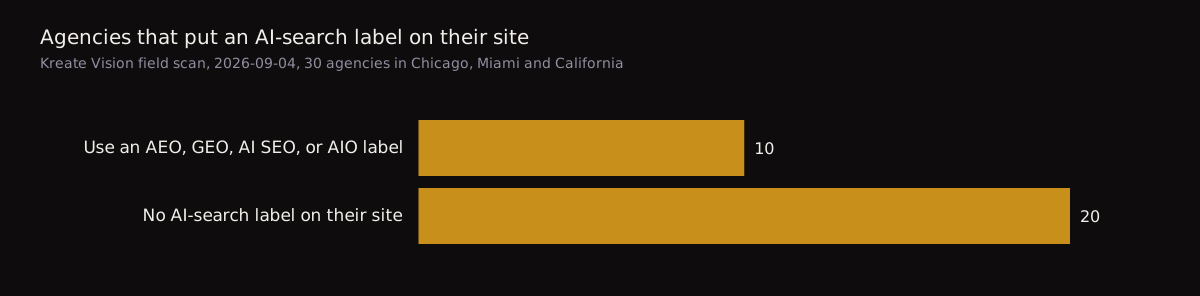
We build sites in Astro, static and fast, with schema and direct-answer copy handled as part of the same SEO and AEO work, not a separate line item nobody defines. In our own scan of 30 web design agencies across Chicago, Miami, and California on 2026-09-04, 10 of 30 put “AEO,” “GEO,” “AI SEO,” or “AIO” somewhere on their own site, and none of them described what gets delivered or measured (Kreate Vision field scan, 2026-09-04). A label is not a method.
We quote a fixed price after one conversation, and the same team that builds the site also runs Meta ads for clients working on the third-party visibility this post describes as the slowest fix to earn. See what we’ve built at our work page, or run the six prompts yourself first. We’re in Palatine, Illinois: (224) 328-2853.
Sources
- Google Search Central, “AI features in Search”, read 2026-09-04
- OpenAI, “Bots” (redirected from platform.openai.com/docs/bots), read 2026-09-04
- Perplexity, “Bots”, read 2026-09-04
- Anthropic, “Does Anthropic crawl data from the web, and how can site owners block the crawler?” (redirected from support.anthropic.com), read 2026-09-04
- kreatevision.com/robots.txt, read 2026-09-04
- Kreate Vision field scan, 2026-09-04 (internal, 30 competitor sites)
How do I check if ChatGPT recommends my business?
Type your service and town into ChatGPT, Google, and Perplexity using a few phrasings, such as "who is a good [service] in [town]." Read whether your business is named in the answer, cited as a linked source, or absent from both. This takes about five minutes across the three platforms and needs no separate tool.
What is the difference between being named and being cited in an AI answer?
Named means your business appears by name inside the answer's own text, as a recommendation. Cited means your page shows up only as a linked source under the answer, while the text names competitors instead. Cited without named still means the model read and trusted your page. Absent means neither happened.
Why would a business be missing from AI answers even with a normal website?
Three reasons cover most cases: the site's robots.txt disallows the crawler for that AI company, no single page states the business's name, service, towns, and address plainly, or no outside source, such as a directory, press writeup, or review site, mentions the business at all. Any one of the three can keep a real business out of an answer.
Does fixing robots.txt or adding schema guarantee my business shows up in ChatGPT?
No. Unblocking a crawler or stating your entity plainly removes a reason an AI could not have found or trusted your page. It does not force a specific answer. Nobody outside the AI companies knows exactly how each answer gets assembled, so treat these fixes as removing blockers, not buying a guaranteed citation.