







Should a Chicagoland business have city pages?
By Krystian Swierk, Kreate Vision, Palatine IL
Sometimes. Full-scale location-page programs can work, but the honest answer for most Chicagoland businesses is one or a few, earned, not a farm of them. We measured 90 days of Google Search Console data from a remodeling contractor client on Chicago’s North Shore, and the pattern is specific enough to name: 36 town pages, 71,046 impressions, 29 clicks.
The 36 pages, in numbers
Between June 2 and August 30, 2026, this client’s /service-areas/ pages, one per town, showed up in Google search results 71,046 times across 36 towns with any impressions at all. They were clicked 29 times. Average position across those 36 pages: 19.2, which sits past the bottom of page one and into page two.
Twenty of the 36 pages got zero clicks in the full window. The click-through rate across the cluster works out to 0.04 percent, meaning that for every 10,000 times Google served one of these pages, a searcher opened it 4 times.
Scale that against the whole site. In the same 90 days, this client’s entire site drew roughly 715 to 720 total clicks and roughly 128,000 to 150,000 total impressions (Google Search Console’s own totals disagree slightly depending on how they’re queried, so we’re reporting the range rather than picking one number). These 36 town pages alone account for roughly half of the site’s total impressions (71,046 of that 128,000-to-150,000 range), and about 4 percent of its total clicks (29 of that 715-to-720 range).
Top 10 town pages by impressions, same 90-day window.
| Town | Impressions | Clicks | Avg. position |
|---|---|---|---|
| Kenilworth | 7,327 | 1 | 10.6 |
| Evanston | 7,075 | 6 | 18.4 |
| Mount Prospect | 4,566 | 0 | 15.7 |
| Deerfield | 3,909 | 0 | 15.6 |
| Lake Forest | 3,815 | 2 | 31.2 |
| Winnetka | 3,337 | 1 | 20.1 |
| Lake Bluff | 3,116 | 3 | 15.0 |
| Arlington Heights | 3,115 | 2 | 21.6 |
| Highland Park | 2,967 | 0 | 30.2 |
| Wilmette | 2,767 | 0 | 20.3 |
Kenilworth is the clearest single case: 7,327 impressions, 1 click. Google decided the page was relevant enough to show 7,327 times. A buyer decided it was worth opening once.
Position 19 is page two, and page two doesn’t get chosen
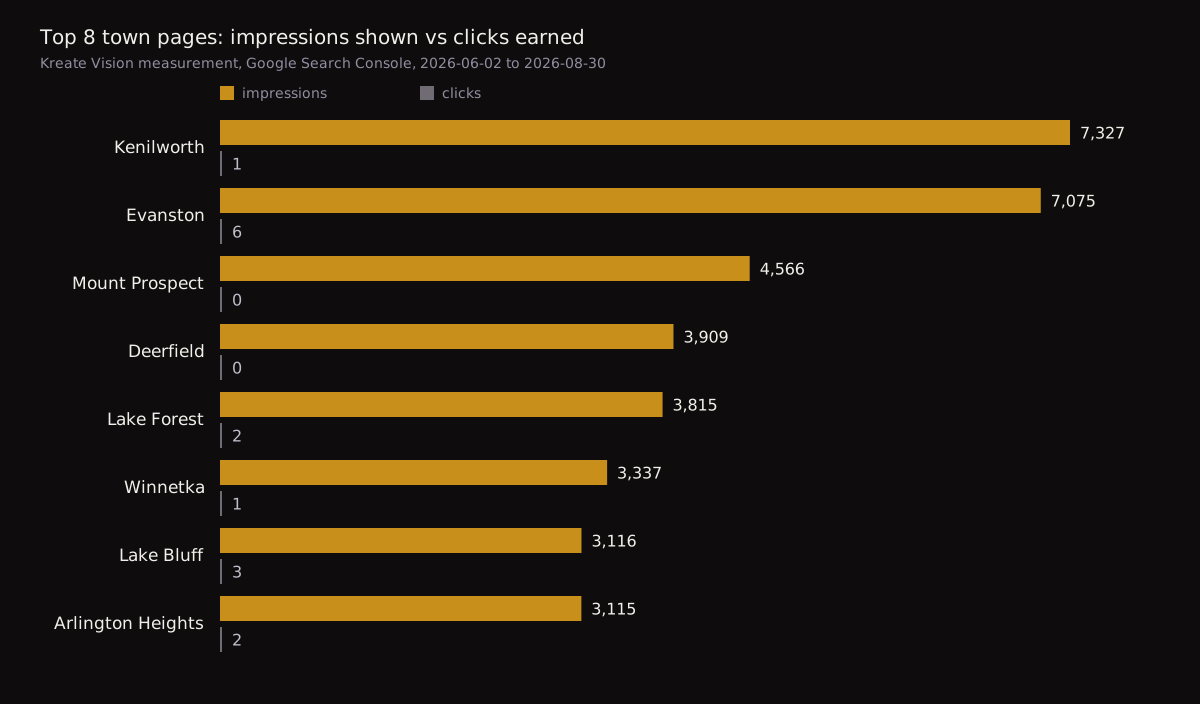
Position 19.2 average across the cluster means most of these pages sit on Google’s second results page. Most searchers never click past the first page, which is why a page can be indexed, relevant enough to surface, and still go unclicked. Google showing a page is not the same signal as Google ranking it where anyone looks.
There’s a second reason a thin town page loses even when it does surface: a searcher typing “[town] remodeler” usually sees the local pack, three map-pinned businesses with reviews and a phone number, above any organic result. A text page with a swapped city name is competing with that pack and, often, with the client’s own homepage for the same query. Neither fight favors the thin page.
The accessibility pages show the same shape
This isn’t unique to town pages. The same client runs a cluster of accessibility and handicap-remodeling pages, 71 pages with any impressions over a comparable 90-day window (May 31 to August 28, 2026). That cluster drew 8,105 impressions, 18 clicks, a 0.22 percent click-through rate, and an average position of 16.5.
Same pattern: Google shows the pages. Position sits past where most buyers look. Clicks stay low. Two different content clusters, two different topics, the same shape: volume without conversion when the page sits at position 15 to 30.
When a city page is a doorway page, not a service page
Google’s own spam policy has a name for this failure mode: doorway pages. Google’s definition, verbatim, describes pages “created to rank for specific, similar search queries” that “lead users to intermediate pages that aren’t as useful as the final destination,” and it names the exact pattern directly: “multiple domain names or pages targeted at specific regions or cities that funnel users to one page.”
That’s the risk in a location-page program built by swapping a town name into an otherwise identical template. Google’s helpful-content guidance asks a simpler question to test for it: was this page made primarily to attract search traffic, or to help the person who lands on it? A page with a town’s name in the H1 and nothing else specific to that town answers that question honestly, and not in the page’s favor.
We found the same instinct on the agency side, not just the client side. In a same-week scan of 30 web-design competitors across three U.S. markets, we found at least one agency ranking in Chicago search results on the strength of a city-keyword landing page while listing no office, phone number, or local presence in that city, with nine other “markets served” pages built the same way. A city page built to rank for a place, not to serve people in that place, is the same move whether a contractor or an agency runs it.
Which towns actually deserve a page
Not every town in a service radius needs one. A town earns a page when there’s something specific to put on it: a completed job with real photos from that address, a review naming that town, a permit or code detail specific to that municipality, a distance or drive-time fact that matters to that buyer. Absent that, a page is a name swap wearing a template.
The data above backs a simple filter. Look at which towns in a cluster have any clicks at all, not which have the most impressions. In this dataset, Evanston (6 clicks) and Lake Bluff (3 clicks) outperformed higher-impression towns like Mount Prospect and Deerfield, which sat at zero. Impressions tell you Google considers the page relevant enough to show. Clicks tell you whether a real person agreed. Build where the second number has a chance, not just the first.
One strong service-area hub, built around the towns with real proof, beats twenty thin pages stamped from the same template. It also beats splitting a client’s own homepage and its town pages against each other for the same search term, which is the quiet cost of an over-built cluster: it isn’t just wasted pages, it’s pages competing with your own best page.
What this means for a Chicagoland business
If you’re in Palatine, Arlington Heights, or anywhere in the northwest suburbs weighing a location-page build, start from the towns where you can point to a finished job, not from a list of every town within driving distance. Write what’s actually true about that town: the permit process, a specific street or neighborhood, a client’s name and the work done there.
This is the same discipline we bring to web development and SEO and AEO work: build what earns its place, measure what it actually does in Search Console, and don’t publish a page that only exists to catch a keyword. We quote a fixed price after one conversation, and that conversation includes looking at what a client’s existing pages are doing before we add more. See our approach on our work page, and for the mechanics behind pages that get read by both search engines and AI answer engines, see SEO gets you ranked, AEO gets you quoted and website speed is a revenue number.
For the related pattern on this same client’s blog, where one post carries most of the clicks, see one post, most of the clicks. For what a location-page build costs relative to a full redesign, see what a remodeler website costs in the Chicago suburbs, and for the risk of losing rankings mid-rebuild, see redesign without losing rankings.
Sources
- Google Search spam policies, doorway abuse section, read 2026-09-04
- Google, creating helpful, reliable, people-first content, read 2026-09-04
- Kreate Vision measurement, Google Search Console, 2026-06-02 to 2026-08-30 (service-area pages) and 2026-05-31 to 2026-08-28 (accessibility cluster)
- Kreate Vision field scan, 2026-09-04
Do location pages help local SEO?
Sometimes. In a 90-day measurement of 36 town pages for one Chicagoland client, the pages drew 71,046 impressions but only 29 clicks, average position 19.2. Google indexes and shows the pages. Buyers mostly don't click them at that position. A page with real proof for that town performs differently than a page with a swapped city name.
How many city pages should a contractor have?
As many as you can back with a real job, a photo, a review, or a permit story for that town. In the data we measured, the towns with any clicks were not reliably the highest-impression towns, which points at content and proof, not page count, as the lever.
What is a doorway page in SEO?
Google's spam policy defines doorway pages as pages built to rank for near-identical queries that funnel visitors toward one real destination, explicitly including 'multiple domain names or pages targeted at specific regions or cities that funnel users to one page.' A city page with the town name swapped in and nothing else town-specific fits that description.
Is one service-area page better than twenty thin ones?
For most Chicagoland home-service businesses, yes. One strong hub with real proof outranks a template stamped across twenty towns, because [Google's helpful-content guidance](https://developers.google.com/search/docs/fundamentals/creating-helpful-content) asks whether a page was made for people or for search engines, and a swapped-name page answers that question for you.