




We rendered 30 web design agency homepages. Here's what shows up
By Krystian Swierk, Kreate Vision, Palatine IL
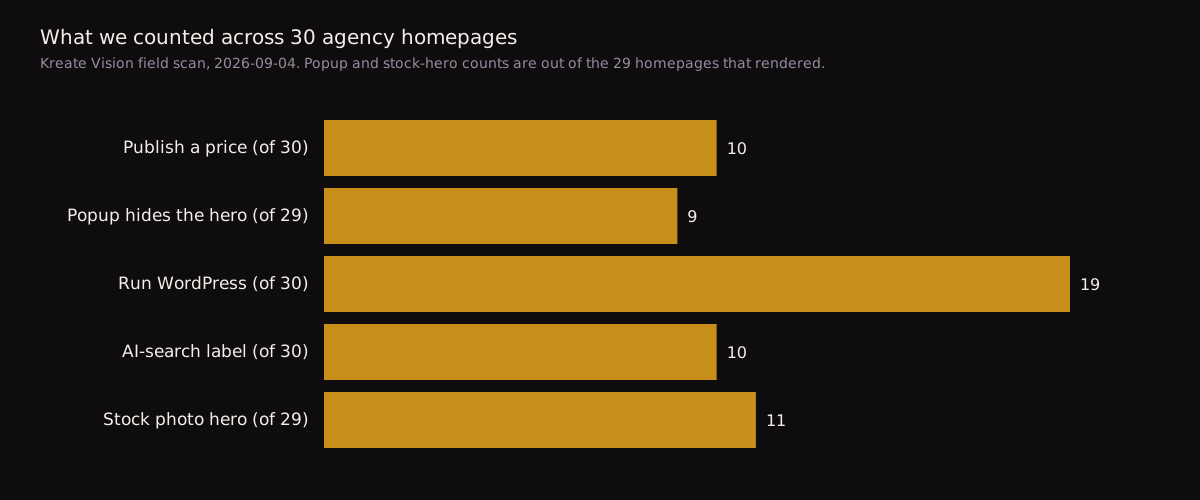
Two thirds of the 30 web design agencies we looked at will not tell you a price until you get on a call with them. We know because we rendered their homepages and counted what was actually on the page.
We did this the way a business owner would: we opened each site and looked at what loaded first. 30 agencies, in Chicago, Miami and California, fetched on 2026-09-04. We rendered and screenshotted 29 of them at 1440x900, so we could see the first fold the way a visitor sees it before scrolling or clicking anything. Here are eight things that showed up, and the question each one should make you ask.
Two thirds make you ask for a price
20 of the 30 homepages we looked at publish no dollar figure at all. Instead you get “custom scope,” a contact form, or a “free proposal” link. That is not automatically a bad sign. Some real, custom work genuinely can’t be priced without a conversation. But it does put the buyer in a weaker position on the first call.
The 10 that do publish a number vary widely. One publishes a flat starting price with itemized add-ons. Another lists three fixed tiers from just under $2,500 to $8,500 and up. Others post a range in the thousands.
A published range tells you something a “let’s talk” button never will: roughly what tier of buyer the agency built its business for. If you can’t find that number anywhere on the site, ask for it before the call, not during it. See what a remodeler website actually costs in the Chicago suburbs for a breakdown by project type.
Nearly a third hide their own hero behind a popup
9 of the 29 homepages we rendered showed a cookie banner, a consent modal, or a welcome popup covering part of the hero. It happened the moment the page loaded. On one, a “Bienvenido” welcome modal sat over the entire page before you could read a word of the actual site.
An agency’s own homepage is the one page in the world it has complete control over: no client deadline, no legacy CMS, nothing to blame. If that page still loads with something blocking the message, ask what the plan is for keeping that off your site. A launch deadline will make that same tradeoff again.
19 of 30 run on WordPress, most through a page builder
19 of the 30 agencies we looked at build their own homepage on WordPress. Elementor or WPBakery, the two most common visual page builders, showed up in the raw HTML of at least 9 of them.
WordPress itself is not the issue, it runs a large share of the web and can be built well. The real question is what you own when the project ends. A page-builder site is usually tied to that builder’s plugin license and the agency’s specific setup. Move it to another host or hand it to another developer, and pieces can break. Ask plainly: if you stop paying for hosting or maintenance next year, can someone else pick up the actual code, or only the export?
Badges say a lot. Named quotes say more
Across the field, the most common trust signal was a number with nothing behind it. One homepage reads “150+ 5-Star Reviews” with zero testimonials shown. Another reads “300+ 5 Star Reviews” with no platform named. A third says “Trusted by 300+ companies” next to two case studies.
One badge on a California homepage credited an AI chatbot as the source of a “Top Agency” award. That is not how any verifiable award works.
About 10 of the 30 agencies cleared a much simpler bar: a testimonial with a real person’s name, a title, and a company attached. That was the proof pattern that held up under a second look, because it points to someone you could actually search for. When you’re comparing agencies, skip the review-count badge and go looking for one quote with a name on it. If it isn’t there, ask for one directly.
”AI SEO” is a label on 10 of 30 homepages. Ask what it delivers
AEO, GEO, “AI SEO,” and “AIO” appeared on 10 of the 30 homepages we scanned. Each is the agency’s own term for optimizing a site for AI answer engines rather than only Google’s results page. Not one of the 10 described what gets built, what gets measured, or how success is reported.
The label by itself tells a buyer nothing. Structured data, direct-answer content, and crawler access for AI tools are real, specific things an agency can build and show you. We write about what actually makes a page citable to an answer engine separately.
If a homepage lists “AI SEO” as a service, ask what one concrete thing they will change on your site. Ask how they’ll show you it worked. If they can’t, it’s marketing language sitting on top of a regular SEO package. Before you pay for the label, ask whether your business shows up when someone asks ChatGPT about it.
Only 4 of 29 first folds read as custom
Four of 29 rendered first folds read as custom. We rated each homepage’s first fold on a 1-to-5 scale for whether it looked custom-built or like a template with the logo swapped. 4 of 29 earned a 4, the highest rating anyone reached. 19 of 29 rated a 1 or a 2.
The single most common tell was a stock or composite photo hero, on 11 of the 29 sites. That meant a stock lifestyle photo, a generic office interior, or a composite image built from stock parts. A homepage doesn’t have to be dark or dramatic to look custom. One of the sites we rated a 4 uses a light, editorial layout with real portfolio thumbnails instead of a photo at all.
Ask to see three other client sites the agency built. If the layout, the fonts, and the photo style repeat across all three, that is your first fold too.
Watch for an agency ranking your city from somewhere else
In the Chicago set alone, one of the ten agencies we found ranking for “web design Chicago” is headquartered in San Francisco. Its own homepage title tag says “San Francisco.” Its FAQ states plainly that it serves clients nationwide, listing Chicago as one of nine markets served, with no Chicago address or phone published anywhere on the page. A second agency in that same set is based over two hours downstate. It reaches the northwest suburbs through a dedicated landing page for that market, not an office there.
A city-specific landing page is not dishonest by itself, but it is a page built to rank, not a location. If you want a genuinely local agency, ask for the street address. Ask for a project for a business in your specific area, separate from the market the page targets.
One homepage was still running its unfinished counter
On one of the 29 sites we rendered, a stat counter was supposed to animate up to a real number. It was still sitting at “0 Talented Team Members” when we captured it, a template placeholder nobody had gone back to fill in. On another, the entire hero area rendered blank at our capture width: no photo, no headline, just white space until you scrolled.
Both were live on a page that exists to sell web design. A single instance out of 29 isn’t a market-wide pattern. But it’s a reminder that a homepage’s first impression is only as good as the last time someone on that team looked at it the way a stranger would. That is a fair thing to ask any agency: when did you last check your own homepage the way you’re about to check mine?
The eight patterns from our scan, out of 30 web design agency homepages (two figures are out of 29 homepages we could render).
| # | Pattern | Count | Question to ask |
|---|---|---|---|
| 1 | No price published, you have to ask | 20 of 30 | ”Can you show me a number before I get on a call?“ |
| 2 | Popup or consent modal covers the hero on load | 9 of 29 | ”What does the page look like the second it loads?“ |
| 3 | Runs on WordPress, mostly via a page builder | 19 of 30 | ”If I stop paying you, can someone else edit this?“ |
| 4 | Badge claims with no name attached | common across the field | ”Can I see one testimonial with a name and company?“ |
| 5 | ”AI SEO,” AEO or GEO label, no explanation | 10 of 30 | ”What specifically gets built, and how do you measure it?“ |
| 6 | First fold reads as templated, often a stock photo hero | 19 of 29 rated 1-2; stock hero 11 of 29 | ”Can I see three other client sites you built?“ |
| 7 | Ranks for your city from another state | at least 1 of 10 Chicago-market sites checked | ”Where is your office, and who’s local to my area?“ |
| 8 | Unfinished template placeholder still live on the page | documented once in 29 renders | ”When did you last look at your own homepage?” |
Five questions for the first call
- Can you show me a real price, or a range, before we talk?
- What happens to my site’s code and hosting if I leave?
- Can I see one testimonial with a full name and company?
- If you offer “AI SEO” or AEO, what specifically will you build and measure?
- Where’s your office, and can I see a project for a business near me?
What this means for a Chicagoland business
We’re a Palatine, Illinois shop, and the eight questions above are fair to ask us too. We quote a fixed price after one conversation instead of a range. Our work page and SEO and AEO service page say plainly what gets built. We hand-code every site in Astro, so the code is yours, not a rented page-builder seat. Our web development pages carry no popups over the hero, and any capture we show a client gets a date on it. That’s the whole pitch: check the same eight things on us that you’d check on anyone else.
Sources
- Kreate Vision field scan, 2026-09-04, 30 agencies in Chicago, Miami and California.
What's a red flag when I'm shortlisting a web design agency?
A homepage that will not tell you anything concrete: no price, a stock photo hero, and reviews with no name attached. In a scan of 30 agency homepages, 20 made a visitor ask for a price before seeing a number, and only 10 of 30 carried a testimonial with a real name, title and company next to it.
Does it matter if a web design agency's own site runs on WordPress?
It matters for what your site does after launch, not for whether WordPress can build a good site. In our scan, 19 of 30 agencies ran their own homepage on WordPress, most through a page builder such as Elementor. Ask whether your finished site needs that agency's builder license and plugin stack to keep working, or whether you own the code outright.
Is "AI SEO" or "AEO" a real service, or just a label?
On its own, it is a label. 10 of 30 agencies in our scan put AEO, GEO, AI SEO or AIO on their homepage, and none explained what gets built, tracked or measured under that name. Before paying for it, ask the agency to name the specific thing they will change on your site and how they will show you it worked.
How can I tell if a testimonial on an agency's site is real?
Look for a full name, a job title, and a company you could search for and confirm. In our scan, badge-style claims such as unlinked review counts or a customer count sitting beside two or three case studies were common. A named, titled quote next to a real company was rarer, and it was the trust signal that held up.